
Introduction
Global trade has entered a period of accelerated complexity. Importers are facing record-high and constantly fluctuating tariffs, rising compliance demands, and the full impact of the de minimis exemption ending. These factors are forcing companies to revisit how they manage costs, protect margins, and maintain operational certainty. As a result, Foreign Trade Zones (FTZs) are emerging as a highly effective strategy to build in predictability amid uncertainty, but the increase in regulatory requirements has made FTZ operations far more demanding. The role of FTZ software, therefore, has shifted from a helpful tool to something that is critical for staying cost efficient and compliant.
Key Takeaways
- Tariff increases, supply chain pressures, and the removal of the de minimis exemption have significantly increased import costs.
- FTZ participation offers major financial benefits, including duty deferral, duty elimination on exports, inverted tariffs, and substantial Merchandise Processing Fee (MPF) savings.
- The operational and compliance requirements of running an FTZ have become too complex for manual tools and spreadsheets.
- Modern FTZ software provides the automation, accuracy, and audit readiness needed to manage risk and maintain consistent compliance.
- Companies evaluating FTZ solutions should look closely at automation, inventory control, integration capabilities, scalability, and reporting strength.
Why FTZs Matter More Than Ever
Tariff increases, shifting regulatory policies, and the expiration of the de minimis threshold have reshaped cost structures across supply chains. Goods valued under $800 that were once duty-free now incur duties, creating significant new exposure for ecommerce and consumer brands. At the same time, tariff rates in some categories exceed 145 percent, putting new margin pressure on manufacturers and distributors. These shifts are pushing companies to find stable, proven methods to reduce duty costs and regain financial control.
Foreign Trade Zones have become one of the most effective tools to achieve this. FTZ participation enables companies to defer duties until goods enter U.S. commerce, eliminate duties entirely on exports, and leverage inverted tariff benefits where finished goods carry lower duty rates than their components. Weekly entry consolidation can also generate substantial savings by reducing the number of Merchandise Processing Fees paid each year. For high-volume importers, weekly entry alone can translate into annual savings that exceed one million dollars.
In short, FTZs have moved from a niche strategy to a mainstream necessity for companies managing large import volumes or facing ongoing tariff exposure.
How FTZs Differ from Bonded Warehouses
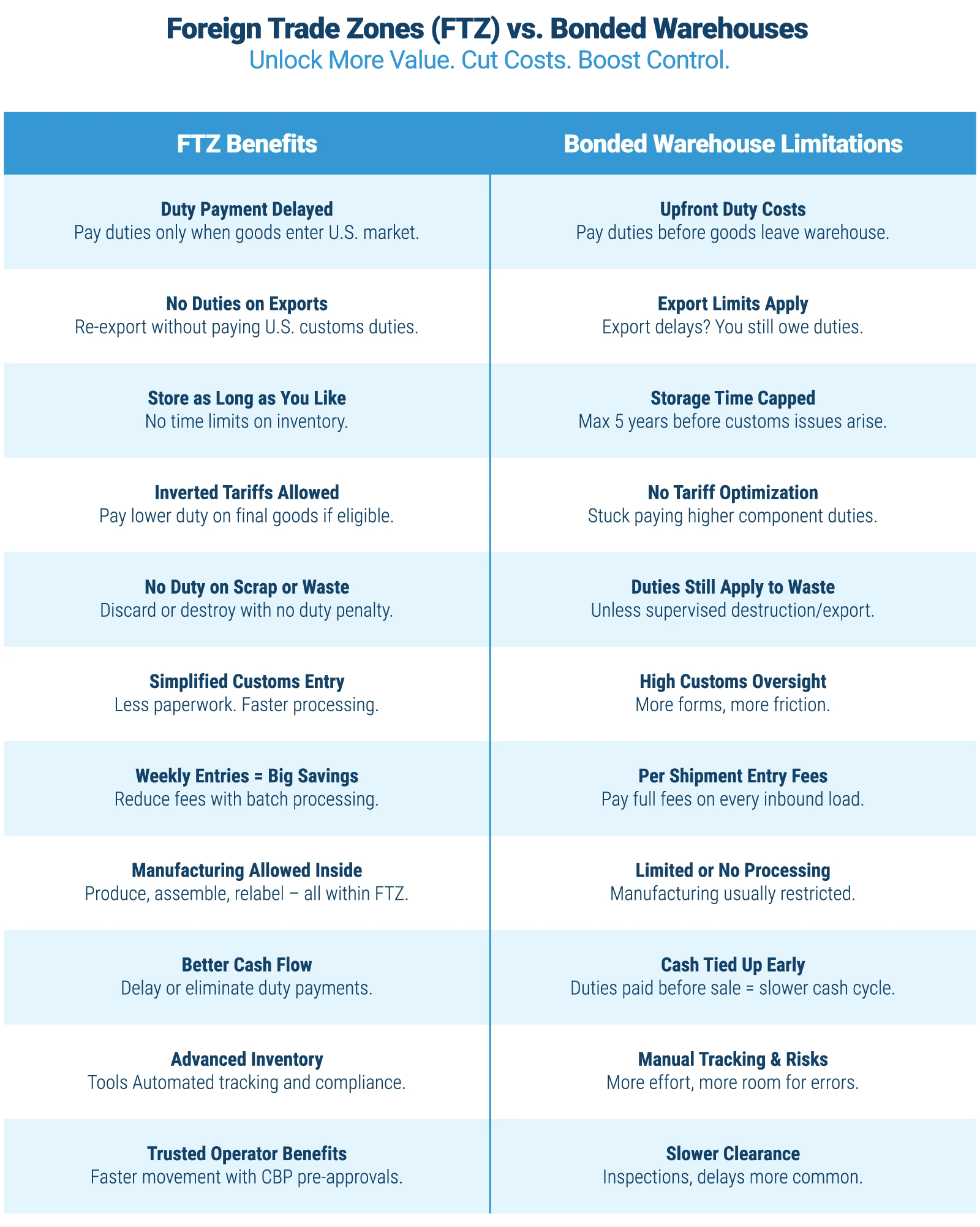
While bonded warehouses and Foreign Trade Zones both allow importers to defer duties, the advantages of FTZs are significantly broader. Bonded warehouses require goods to be exported or enter U.S. commerce within a limited timeframe, whereas FTZs offer indefinite storage with no mandatory re-export deadlines, giving companies far more operational flexibility. FTZs also streamline logistics through centralized entry processing, fewer U.S. Customs and Border Protection (CBP) inspections, and simplified compliance with certain federal agencies. Additional benefits, such as direct delivery options, relief from some country-of-origin marking requirements, and inventory-related property tax savings in states like Texas and Arizona, can further reduce costs and administrative burden.
As FTZ operations continue to modernize through digital customs platforms, importers gain access to real-time compliance tools, automated entry filings, and even Environmental, Social and Governance (ESG)-oriented reporting such as carbon tracking. Compared to bonded warehouses, FTZs deliver a more comprehensive framework for reducing duty liabilities, lowering customs-related fees, and building long-term resilience in today’s increasingly complex trade environment.
Figure 1 Foreign Trade Zones vs. Bonded Warehouses
Why FTZ Operations Have Become More Challenging
While the benefits of FTZs are considerable, the operational requirements have grown increasingly complex. U.S. Customs and Border Protection requires precise, real-time tracking of every Stock Keeping Unit (SKU) inside the zone, including zone status designations, audit trails, and traceability from admission to entry. Operators must file electronic admissions, maintain accurate 3461 and 7501 entries, perform daily reconciliations, and remain perpetually audit ready.
These activities involve high volumes of data and require consistency across logistics, compliance, and finance teams. Many organizations still rely on spreadsheets, manual processes, or legacy systems that cannot deliver the accuracy CBP expects. The risk is significant. Incomplete records, mismatches between physical and system inventory, delayed filings, or missing audit data can result in penalties, shipment delays, or even the suspension of FTZ privileges.
Given these stakes, modern FTZ operations require automation, integration, and reliable data controls that manual methods cannot support.
Why FTZ Software Has Become a Necessity
FTZ software solves these challenges by automating the core processes that carry the highest compliance risk. Automated creation and submission of e214 admissions and 3461 and 7501 entry filings reduces errors and prevents delays. Real-time inventory control ensures zone status is tracked correctly for every SKU, while automated daily reconciliation improves accuracy and eliminates discrepancies before they become compliance issues.
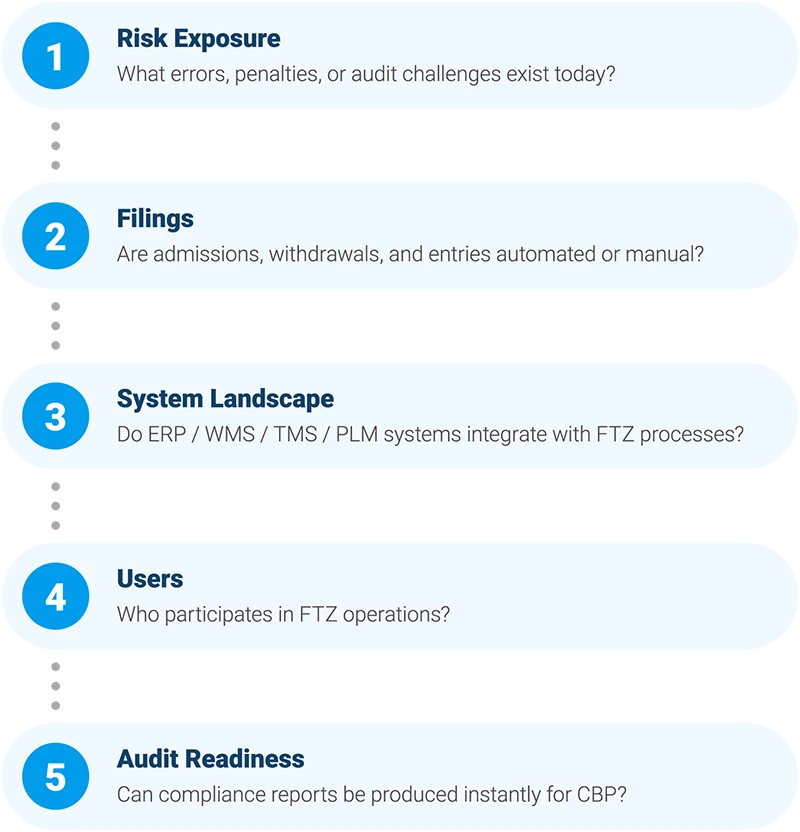
Before selecting an FTZ software solution, companies should conduct a focused needs assessment to understand current FTZ operations and pinpoint where gaps create risk, inefficiency, or compliance challenges. This quick self-audit helps clarify which processes require automation, where data accuracy is breaking down, and what capabilities a new system must support to meet CBP expectations and future growth.
To guide this evaluation, companies can use the following checklist:
Figure 2 Needs Assessment and Gap Analysis
Ultimately, FTZ software transforms FTZ participation from a manually intensive obligation into a strategic, automated process that reduces risk and maximizes financial return.
What to Look for in an FTZ Software Solution
Selecting the right FTZ technology requires careful evaluation. Companies should look for automated admissions and entry filings, strong inventory control that meets CBP requirements, and clear, comprehensive audit trails. Integration flexibility is critical, as is the ability to scale from a single site to multi-zone or multi-client environments. Reporting capabilities matter as well. A strong system should produce instant CBP-ready reports and allow for custom reporting that supports internal audits and management oversight. Finally, usability is a key differentiator. A solution that is intuitive, easy to learn, and supported by expert training ensures better adoption across teams and fewer operational errors.
For more details, download our FTZ Software Buyer’s Guide.
How Descartes Can Help
With tariffs at record highs, the de minimis exemption expired, and economic volatility increasing, companies need agile, automated FTZ solutions that protect margins and strengthen compliance. Descartes QuestaWeb™ provides a unified, cloud-based FTZ platform that helps organizations reduce duty costs, automate CBP filings, and maintain accurate, audit-ready control over every zone activity.
As a recognized global leader in trade compliance technology, Descartes delivers a comprehensive FTZ software solution built for measurable savings, seamless integration, and scalable growth. Descartes QuestaWeb connects directly with Enterprise Resource Planning (ERP) and Warehouse Management Systems (WMS), streamlines inventory and filing workflows, and supports duty deferral, MPF reduction, and duty elimination on exports, scrap, and non-conforming goods.
Choosing Descartes means partnering with a proven expert committed to delivering not just software, but a reliable foundation for long-term FTZ performance and competitiveness in a rapidly changing trade environment.
To explore how Descartes can strengthen your FTZ operations, support compliance, and maximize duty savings, connect with our team or request a demo.