Global trade research has traditionally been driven by complex, manual searches.
An analyst starts with a question, determines which data will answer it, constructs a query, selects filters, reviews potentially thousands of records, adjusts the search, exports the results, and then analyzes what they mean.
The approach provides significant control, but it can also require expertise and time.
Key Takeaways
- Traditional searches give experienced analysts direct control over filters and methodology.
- The Descartes Datamyne AI Agent lets users start with a natural language question and explore trade data conversationally.
- Users can inspect supporting Descartes Datamyne information when validating AI-assisted findings.
- Productivity gains depend on the question and the user’s experience, so teams should test their own workflows.
- Exploratory AI analysis and structured searches can complement each other for consequential decisions.
The Descartes Datamyne™ AI Agent introduces another way to work with trade data: start with the business question instead of the database query.
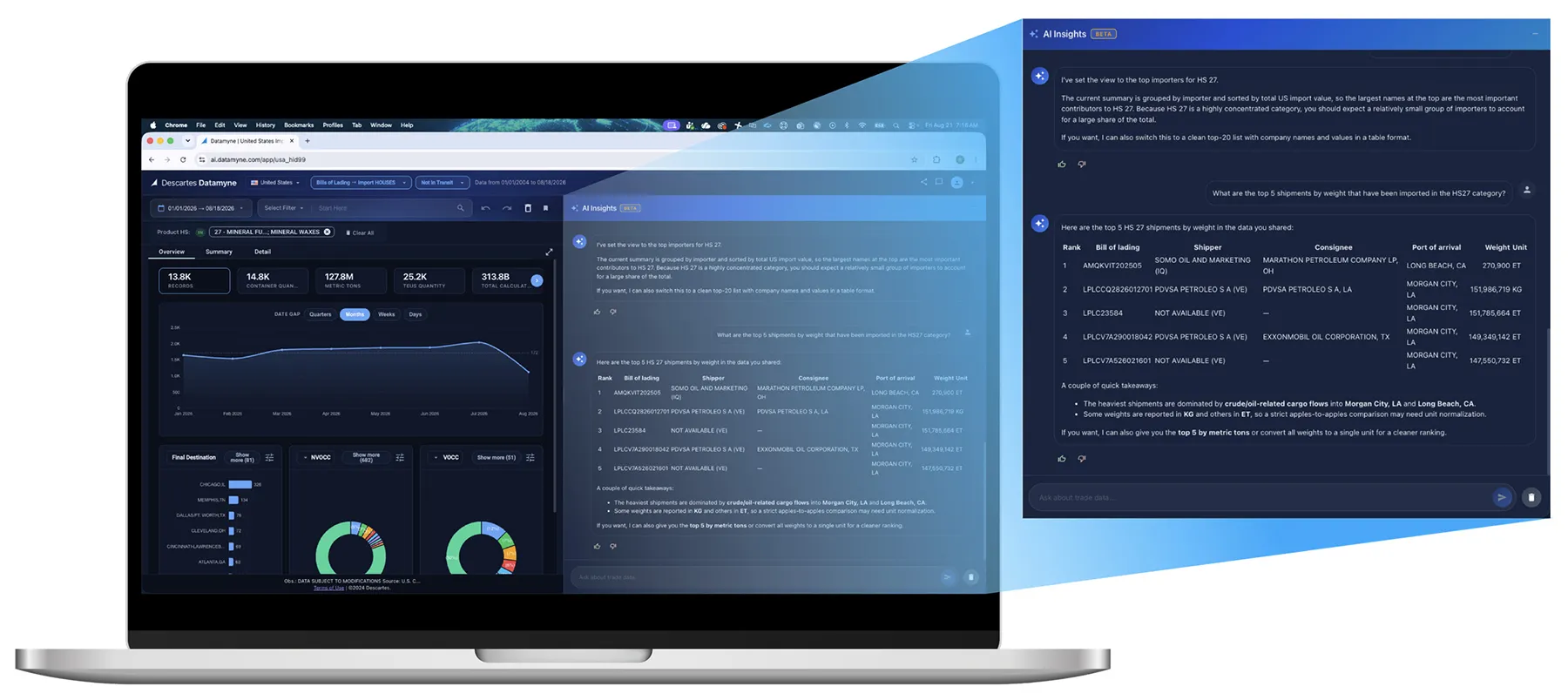
Users can ask questions in natural language and the AI Agent interprets the request, conducts the analysis, presents relevant insights, and connects those findings with the supporting data and visualizations inside Descartes Datamyne.
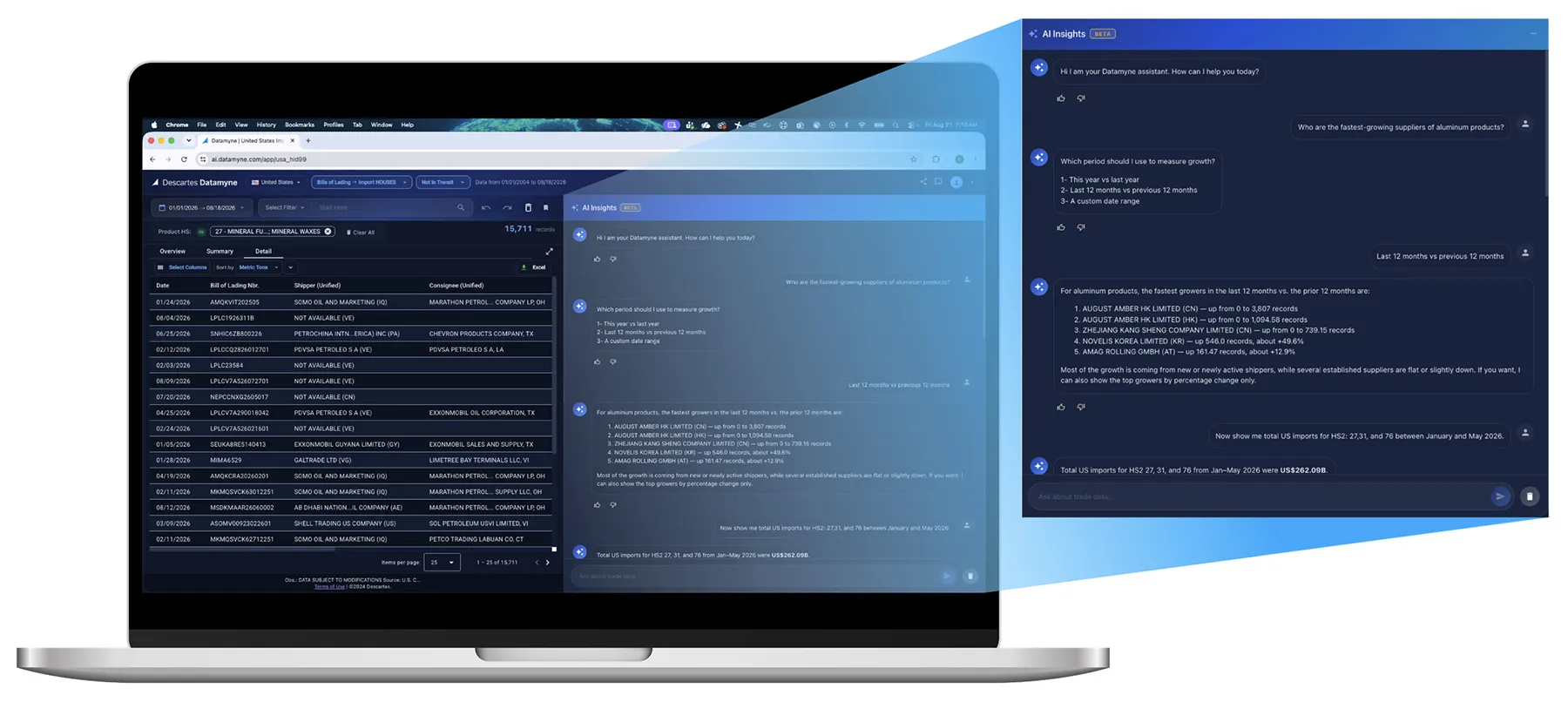
Source: Descartes Datamyne AI Agent
Does that make traditional trade research obsolete?
No, traditional research remains valuable when an analyst wants precise control over methodology, needs to construct a highly specific dataset, or is validating a particularly important conclusion.
The AI Agent is better suited to accelerating discovery, exploring complex questions, reducing repetitive research steps, and making trade intelligence more accessible to people who may not be expert database users.
The strongest workflow may combine both.
What Does Traditional Trade Research Look Like?
Consider a relatively common question:
Which suppliers of a particular product are gaining market share in the United States?
Before answering it, an analyst may need to determine the appropriate HS codes, define the time period, choose countries, decide whether to analyze value, weight, TEUs or shipment counts, configure filters, identify the companies involved, compare periods, export results, calculate growth and interpret what changed.
If the first query does not answer the question, the analyst adjusts it and tries again. Many trade professionals and Descartes Datamyne users can perform sophisticated research this way. Traditional search is powerful precisely because analysts can specify exactly what they want. However, the trade-off is that users must understand how to translate a business question into a series of database operations.
How Does the Descartes Datamyne AI Agent Evolve That Process?
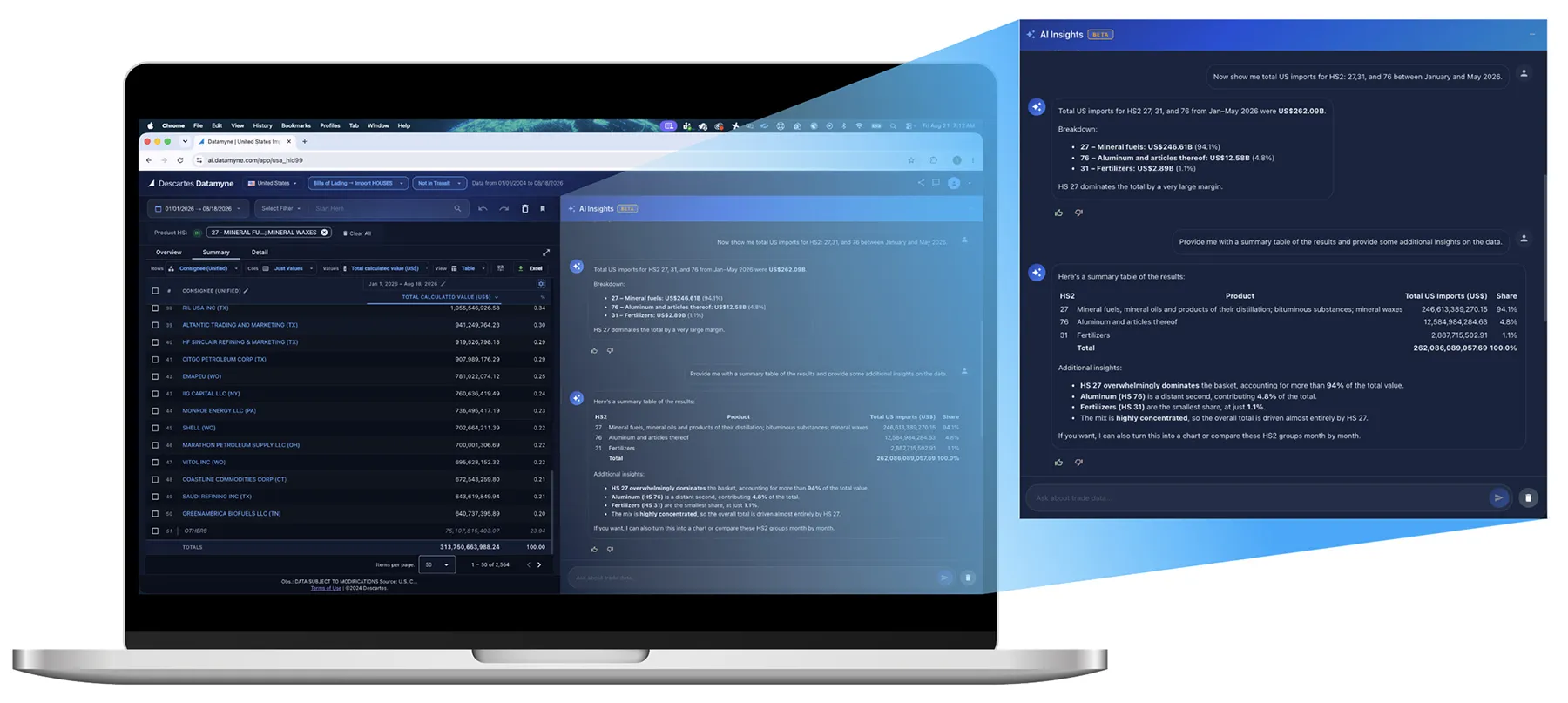
The AI Agent moves that translation step into the platform. Instead of deciding which sequence of searches and filters will answer a question, users can describe what they want to understand in natural language.
Source: Descartes Datamyne AI Agent.
For example:
“Which suppliers of this product are growing fastest in the U.S. market?”
The Agent can interpret the intent behind the question, analyze the relevant trade data, summarize significant findings, and dynamically update the underlying data and visualizations so the user can explore the results further.
The difference is fundamental. Traditional research asks the user to tell the database how to search. The AI Agent lets the user begin by telling Descartes Datamyne what they want to know.
Descartes Datamyne AI Agent vs. Traditional Trade Research at a Glance
| Area | Traditional Trade Research | Descartes Datamyne AI Agent |
|---|---|---|
| Starting point | Build searches and configure filters | Ask a question in natural language |
| Platform expertise | Greater knowledge of search methodology may be required | Lower barrier for exploratory research |
| Research process | User determines each analytical step | Agent helps execute and connect analytical steps |
| Result interpretation | Primarily performed manually | AI-generated summaries can highlight trends and anomalies |
| Follow-up questions | Modify filters or build another search | Continue the analysis conversationally |
| Data validation | Review source records and search methodology | Drill into supporting trade data and records |
| Control | High direct control over query construction | Agent interprets the user’s intent |
| Best suited for | Highly structured or analyst-directed research | Exploration, recurring analysis and rapid investigation |
The Biggest Difference: Questions Instead of Database Queries
Trade professionals rarely think naturally in database fields. They think in business questions.
- Which suppliers could replace our current supplier?
- Who are our competitors buying from?
- Which importers are increasing purchases of our product category?
- Which countries are gaining market share?
- Where are companies shifting sourcing away from China?
While traditional research requires users to translate those questions into database logic, the AI Agent allows that conversation to begin much closer to the original question. It supports natural language queries and can perform analysis using the shipment-level trade data available through Descartes Datamyne.
This can make sophisticated trade intelligence easier to access for sourcing teams, sales professionals, executives and other users who may understand the business problem but are less familiar with database query construction.
Analysis Is Often More Time-Consuming Than Search
Finding the records is only part of trade research. The harder question is usually:
What does the data mean?
A search might return hundreds of suppliers or thousands of shipments. The analyst then needs to determine which changes matter.
- Are volumes increasing?
- Is one supplier gaining share?
- Has a company shifted sourcing countries?
- Is the apparent increase temporary, or part of a broader pattern?
Traditional research often requires users to export results and perform additional analysis before these patterns become obvious.
The AI Agent can help automate part of this interpretive work by summarizing results, identifying notable patterns and anomalies, and surfacing potential supplier, competitor or market opportunities. This does not eliminate analysis. It moves the user closer to the part of the process where human judgment creates the most value.
Can You Trust an AI-Generated Trade Analysis?
This should be one of the first questions any buyer asks about an AI research product.
An AI-generated answer is more useful when the user can inspect the evidence behind it.
The AI Agent is built around Descartes Datamyne trade data rather than functioning as a general-purpose chatbot searching broadly across the internet. As users interact with the Agent, the platform can update filters and visualizations and allow them to drill into the underlying shipment information used to support the analysis.
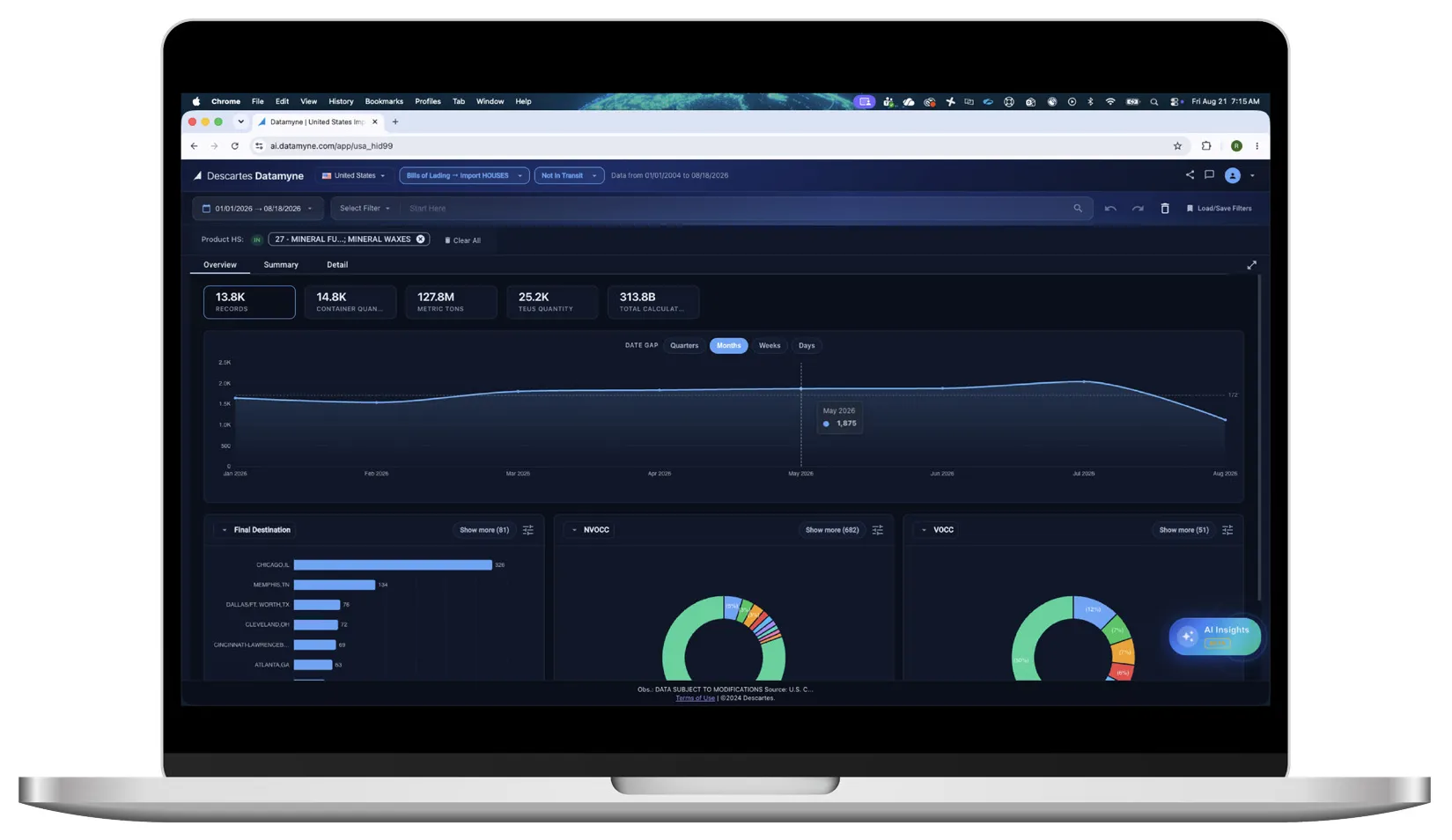
Source: Descartes Datamyne AI Agent
This level of transparency helps AI accelerate the path to an answer, instead of preventing users from checking how the answer was reached.
For important business decisions, users should still review the supporting data, confirm assumptions and apply the same professional judgment they would use with traditionally conducted analysis.
Where Traditional Trade Research Is Still Better
There are several circumstances where building the analysis manually can still be the better approach. An experienced analyst may already know the exact dataset required and want direct control over every filter. A company may have a standardized methodology that must be reproduced consistently. Or the research may require unusual assumptions that are difficult to express clearly in an initial conversational prompt. Traditional research also forces analysts to think explicitly about methodology. Which HS codes are relevant? Which date range should be used? Does shipment count or volume provide the more meaningful comparison? Should related entities be included? Are the results being distorted by a particular market or event? Those questions do not disappear because artificial intelligence is involved. For highly specialized analysis, experienced users may prefer to construct the research themselves—or use the AI Agent to accelerate the initial investigation before validating the results manually.
Where the AI Agent Is Stronger
The Agent becomes particularly valuable when the research question requires multiple steps. Suppose a sourcing professional wants to identify tire suppliers outside China. A traditional workflow could involve identifying the appropriate product classifications, constructing a search, excluding China, evaluating suppliers, comparing shipment activity, calculating volumes, reviewing trends and preparing a shortlist.
Source: Descartes Datamyne AI Agent.
An AI-assisted workflow can begin with a request closer to:
“Identify leading tire suppliers outside China and compare their recent U.S. shipment activity.”
From there, the user can continue refining the analysis conversationally—asking to focus on particular countries, compare suppliers, change the time period, or investigate individual companies. The Agent helps the user perform iterative analyses based on the underlying trade research.
Does the AI Agent Replace Experienced Trade Analysts?
No, experienced analysts understand context, recognize questionable assumptions, know when a classification needs additional investigation, and can distinguish between a statistical pattern and a meaningful business development.
The AI Agent can help analysts spend less time performing repetitive steps and more time evaluating what the results mean. It may also allow less experienced users to conduct analyses that previously required significant platform knowledge, which can broaden access to trade intelligence across an organization while keeping experienced analysts focused on the questions that require their expertise.
What About Research Quality?
Faster research is not necessarily better research. The quality of either approach depends heavily on the question, the underlying data and the assumptions used. Traditional analysis can produce poor results when filters are constructed incorrectly or the analyst starts with the wrong classification.
AI-assisted research can produce weak results when the request is ambiguous or important context has not been provided.
The solution in both cases is similar: refine the question and validate the result.
With the AI Agent, this can become an iterative conversation. A broad initial question can identify an interesting pattern. The user can then ask more specific questions and inspect the underlying data before reaching a conclusion. This makes the Agent particularly useful for exploratory research where the user does not necessarily know the exact query they should build at the beginning.
What About Cost and Productivity?
The direct cost of trade research is not limited to the price of the data platform. Organizations also invest employee time in building searches, reviewing results, exporting data, creating analyses and producing reports. AI-assisted research can reduce many of those manual steps, particularly for recurring or multi-stage investigations.
The exact productivity improvement will vary significantly depending on the complexity of the question and the experience of the user. A simple lookup completed by an experienced analyst may already be fast whereas a multi-step analysis requiring repeated searches, filtering and interpretation offers much more opportunity for efficiency.
For that reason, organizations evaluating an AI research capability should test it against their own real-world workflows rather than relying solely on a generalized productivity percentage.
Should You Use the AI Agent or Traditional Search?
You do not necessarily have to choose. A researcher might use the AI Agent to discover which suppliers appear to be gaining market share, then open the supporting records and perform a more structured comparison. An experienced analyst might use traditional Descartes Datamyne tools to create a precise dataset and then use AI-assisted analysis to summarize patterns within it. A new user may begin conversationally and use the Agent as a way to learn which dimensions of the data are most useful.
The two workflows can complement each other. Traditional search provides direct control while the AI Agent reduces the effort required to turn a business question into analysis.
Who Benefits Most from the Datamyne AI Agent?
The strongest use cases tend to involve users who repeatedly need to move from a broad commercial question to evidence contained in trade data.
- A sourcing professional may want to identify alternative suppliers.
- A sales team may want to discover importers buying a particular product.
- A competitive intelligence analyst may want to understand where a competitor is sourcing.
- A market researcher may want to identify countries or companies gaining share.
- A supply chain team may want to investigate changing sourcing patterns.
These analyses were possible before AI but the Agent changes how users get to the answer. Descartes Datamyne describes capabilities including natural-language queries, automated trade insights, company and shipment analysis, real-time data exploration and workflow assistance.
The Bottom Line
Traditional trade research gives analysts precise control over searches and remains valuable for highly structured analysis, standardized methodologies and detailed validation. Its primary limitation is that the user must know how to translate a business question into the appropriate sequence of searches, filters and analytical steps.
The Descartes Datamyne AI Agent changes that interaction.
Users can start with a natural language question and use the Agent to conduct analysis, surface patterns, explore companies and shipments, and move from initial research to supporting records within the platform. The goal to remove more of the manual work standing between the analyst and the insight.
Talk to Your Trade Data
Want to see how a question your team currently researches manually could be approached with conversational trade intelligence?
Request a personalized demonstration of the Descartes Datamyne AI Agent and test it using the trade questions that matter to your business.