
Key Takeaways:
- Access Comprehensive Global Trade Data: Analyze detailed import, export, shipment, company, and bill of lading data across global markets.
- Find New Customers and Sales Opportunities: Identify and prioritize prospects using verified trade activity and company-level intelligence.
- Get Faster Insights with the AI Agent: Ask questions in natural language and quickly uncover patterns, trends, and opportunities within global trade data.
- Evaluate Tariffs and Landed Costs: Use Tariff Insights to compare duties, understand cost implications, and make more informed sourcing and pricing decisions.
- Discover and Evaluate Suppliers: Analyze shipment history and supplier activity to identify alternatives, validate potential partners, and diversify sourcing.
- Monitor Competitors and Markets: Track cross-border activity and changing trade patterns to strengthen competitive and market intelligence.
- Build Supply Chain Resilience: Use shipment-level global trade intelligence to identify alternatives, understand dependencies, and respond to changing conditions.
Global trade moves quickly. Markets shift, sourcing strategies change, tariffs affect costs, and new competitors and suppliers emerge across borders. For organizations trying to make confident decisions, simply having access to global trade data is no longer enough. The real advantage comes from being able to transform that data into global trade intelligence that teams can act on.
Descartes Datamyne™ brings together comprehensive import and export data, advanced analytics, artificial intelligence, and tariff insights to help organizations better understand global markets, uncover opportunities, manage risk, control costs, and make more informed supply chain decisions.
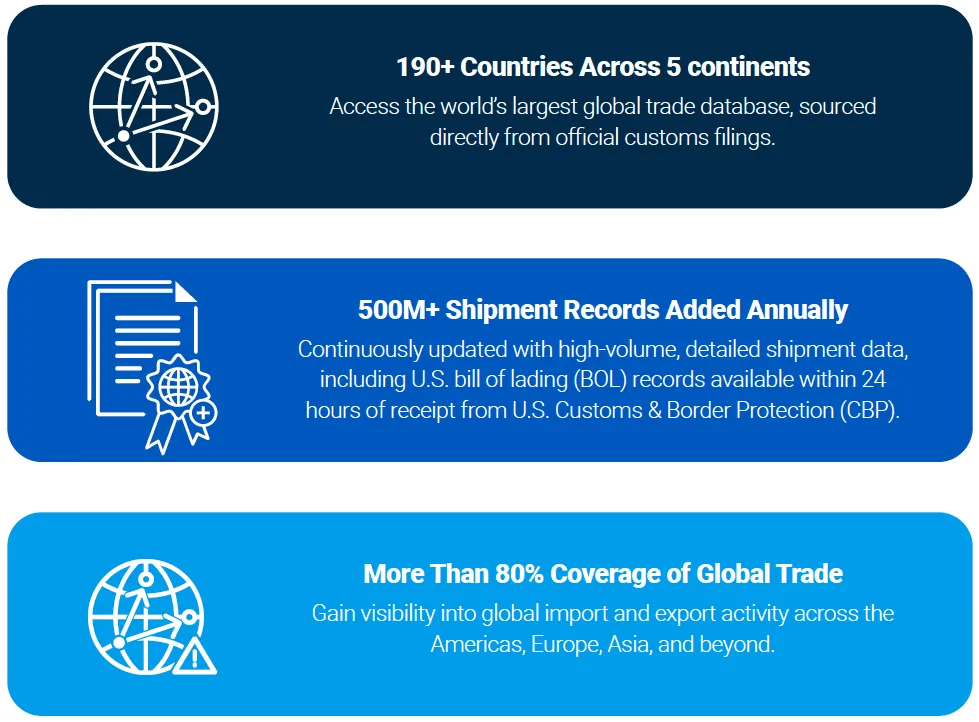
With coverage spanning more than 190 countries across five continents, more than 500 million shipment records added annually, and visibility into more than 80% of global trade, Descartes Datamyne gives organizations a powerful foundation for understanding what is happening across international trade.
Want a closer look at the data, capabilities, and use cases?
One Source for Global Trade Data and Intelligence
International trade generates an enormous amount of information. But finding the right data—and turning it into answers—is often the harder challenge.
Descartes Datamyne simplifies global trade analysis by enabling users to search, filter, and analyze detailed shipment information, including bill of lading data, buyers, suppliers, logistics activity, shipment volumes, countries of origin, ports, carriers, and more.
Instead of viewing trade information in isolation, teams can use this global trade data to investigate markets, understand company activity, evaluate sourcing strategies, identify sales opportunities, and monitor changing trade patterns.
The result is a shift from searching for data to generating global trade intelligence.
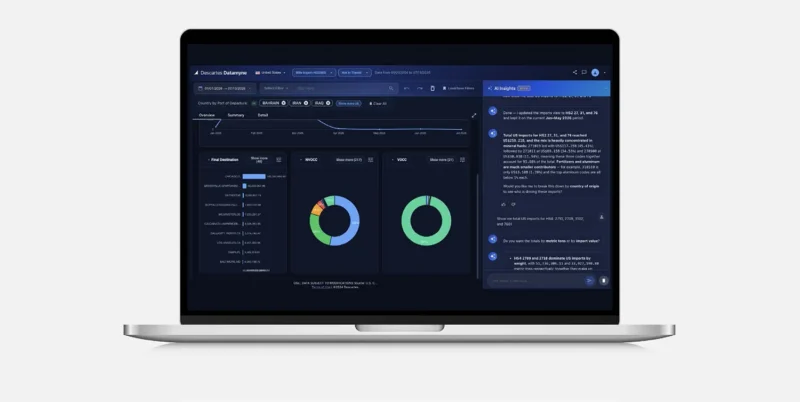
See how Descartes Datamyne turns complex trade information into actionable insights.
Find New Customers and Build a More Targeted Sales Pipeline
For sales and business development teams, trade activity can reveal opportunities that traditional prospect lists may miss.
Descartes Datamyne uses verified shipment activity alongside company-level information to help teams identify organizations actively buying and selling products internationally.
Teams can use the platform to:
- Identify new buyers based on verified import and export activity
- Access company profiles with key business and contact information
- Analyze trade flows by month, carrier, country of origin, and port
- Prioritize prospects based on shipment trends and volume
- Build a more targeted and qualified sales pipeline
This gives sales teams more context before outreach. Rather than simply knowing that a company exists, they can better understand how that company participates in international trade and identify opportunities based on actual activity.
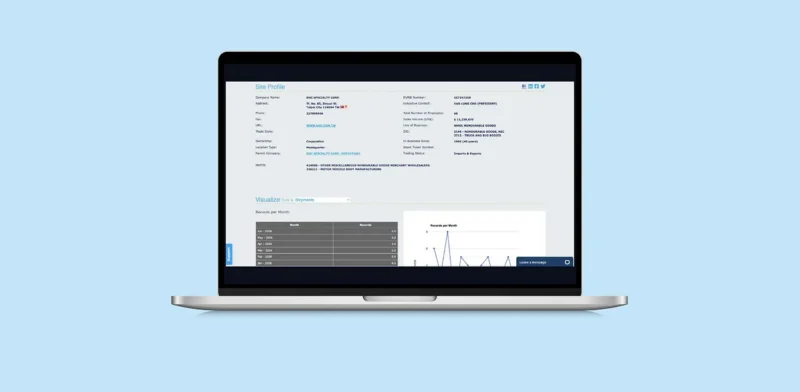
Ask Questions of Global Trade Data with the Descartes Datamyne AI Agent
One of the biggest challenges with large trade datasets is determining how to get from millions of records to the specific insight you need.
AI-powered capabilities in Descartes Datamyne help make that process faster and more intuitive. The Descartes Datamyne AI Agent allows users to interact with trade data using natural language and receive immediate, contextual insights.
Users can ask questions in natural language to:
- Generate insight summaries across shipments, suppliers, and markets
- Identify patterns, gaps, and potential opportunities
- Accelerate research and analysis
- Explore trade information without requiring deep technical expertise
This makes global trade intelligence more accessible across an organization. Instead of relying solely on manual searches and analysis, users can engage directly with the data and quickly move from a business question to relevant insights.
For example, a user investigating a market could begin with shipment data and then use AI-powered analysis to identify notable trends, suppliers, buyers, or changes within those results.
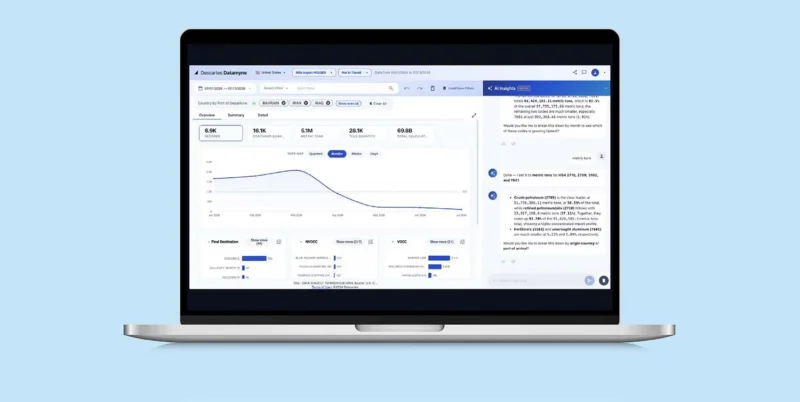
See the AI-powered experience and other Descartes Datamyne capabilities in action.
Understand Tariffs and Landed Costs with Tariff Insights
Trade decisions increasingly depend on more than identifying where a product is coming from. Organizations also need to understand what it could cost to move that product across borders.
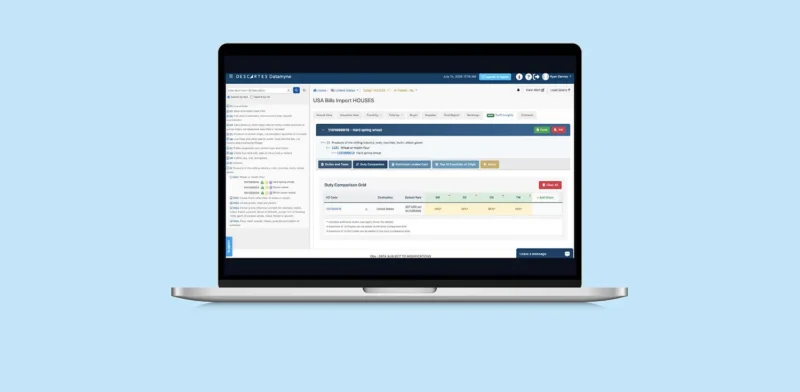
Descartes Datamyne Tariff Insights provides visibility into duties, taxes, and landed cost implications to help organizations evaluate sourcing and pricing decisions in a changing global trade environment.
With Tariff Insights, users can:
- View applicable tariffs and duty rates by product and country
- Compare duties across different sourcing options
- Estimate landed costs to support pricing strategies
- Reduce uncertainty when planning cross-border trade
Combining tariff information with global trade data creates a more complete picture of sourcing decisions.
A supplier or country may appear attractive based on shipment activity or product availability, for example, but applicable duties and other costs can change the economics of that decision. Tariff Insights gives teams additional information to compare those options before acting.
Discover and Evaluate Global Suppliers
Supply chain resilience depends on knowing not only who your current suppliers are, but what alternatives exist.
Descartes Datamyne helps procurement and supply chain teams identify suppliers based on actual shipment activity. Organizations can use historical global trade data to investigate supplier relationships and evaluate potential sourcing alternatives.
Teams can:
- Discover suppliers across global markets
- Compare supplier shipment volumes and performance
- Validate potential suppliers using historical trade activity
- Identify sourcing alternatives
- Diversify supply chains to reduce dependency and risk
Shipment-level intelligence provides valuable context when assessing suppliers because it allows organizations to look beyond a company description or directory listing and examine demonstrated international trade activity.
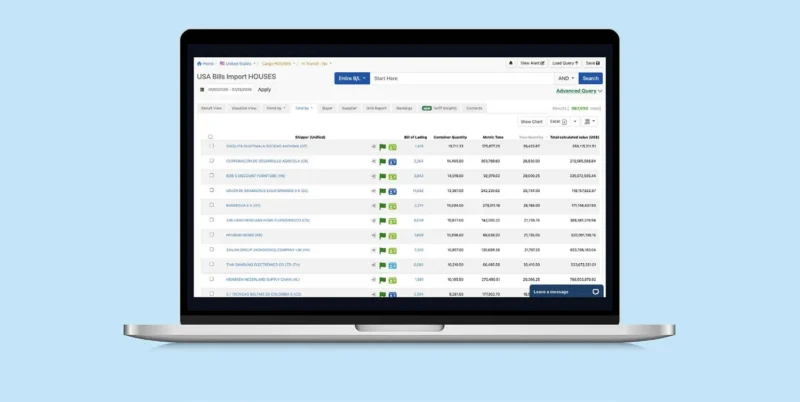
Explore how shipment-level intelligence can support smarter sourcing and supplier decisions.
Monitor Competitors and Understand Market Activity
The same trade information that reveals customers and suppliers can also provide insight into competitors.
Descartes Datamyne enables organizations to monitor cross-border activity and analyze changes in shipment patterns over time. This can help teams understand how competitors are participating in a market and where activity may be shifting.
Organizations can use global trade intelligence to investigate questions such as:
- Which markets are competitors buying from?
- Which suppliers appear within their trade activity?
- How are shipment volumes changing?
- Which ports and carriers are being used?
- Are new companies entering a market?
- Are trade flows shifting between countries?
By examining actual trade activity, organizations can build a more data-driven picture of their competitive environment.
Build a More Resilient Supply Chain
Global supply chains are constantly exposed to change—from shifting trade flows and sourcing conditions to tariff changes and supplier dependencies.
Descartes Datamyne gives teams a broader view of the global trading environment so they can identify alternatives and make more informed decisions when conditions change.
By bringing together shipment-level global trade data, supplier intelligence, tariff information, analytics, and AI-powered insights, organizations can investigate potential risks and opportunities from multiple angles.
That can mean identifying alternative suppliers, comparing sourcing markets, monitoring changes in trade activity, evaluating landed costs, or quickly analyzing a new market.
Rather than reacting with limited information, teams can use global trade intelligence to make more informed decisions based on actual trade activity.
Global Trade Intelligence Built on Extensive Global Coverage
The value of trade intelligence ultimately depends on the underlying data.
Descartes Datamyne provides access to one of the world’s largest global trade databases, sourced directly from official customs filings. Its coverage includes:
190+ countries across five continents
Gain visibility into import and export activity across the Americas, Europe, Asia, and beyond.
500M+ shipment records added annually
The database is continuously updated with detailed, high-volume shipment information. U.S. bill of lading records are available within 24 hours of receipt from U.S. Customs and Border Protection.
More than 80% coverage of global trade
Organizations can analyze trade activity across a broad range of markets to better understand buyers, suppliers, competitors, products, and supply chains.
This breadth gives teams the underlying Global Trade Data needed to move from individual shipment records to a broader understanding of markets and trade activity.
Global Trade Data for Decisions Across the Organization
The value of Descartes Datamyne extends across multiple business functions.
Sales and business development teams can uncover potential customers and prioritize prospects based on verified trade activity. Procurement teams can discover and evaluate suppliers. Supply chain teams can investigate sourcing alternatives and dependencies. Trade and pricing teams can evaluate tariffs, duties, and landed costs. Market intelligence teams can monitor competitors and analyze changing global trade flows.
AI-powered capabilities then help users navigate and interpret that information faster.
Together, these capabilities turn a global trade database into a broader global trade intelligence platform designed to support decisions throughout the organization.
Descartes Datamyne is also used by leading global organizations, while its trade intelligence and related resources are frequently referenced by global media outlets.
Turn Global Trade Data into a Competitive Advantage
Global trade creates enormous amounts of data every day. Competitive advantage comes from knowing how to use it.
Descartes Datamyne brings together comprehensive global trade data, shipment-level analysis, company intelligence, supplier discovery, competitive insights, Tariff Insights, and an AI Agent to help organizations turn complex international trade information into clearer, faster decisions.
Whether the objective is finding new customers, evaluating suppliers, monitoring competitors, understanding tariffs and landed costs, or strengthening supply chain resilience, Descartes Datamyne provides the data and intelligence needed to move from research to action.
Ready to see what global trade intelligence can reveal for your business?
Discover the platform’s capabilities, see the Descartes Datamyne interface, explore Tariff Insights and AI-powered analysis, and learn how organizations can turn global trade information into actionable intelligence.