Tariff research has traditionally required a combination of government tariff schedules, classification resources, spreadsheets, trade databases, and subject matter expertise. For organizations making sourcing or procurement decisions across multiple countries, that process can quickly become complicated.
Key Takeaways
- Traditional research remains important for complex classification and authoritative compliance decisions.
- Descartes Datamyne Tariff Insights supports HS code research, country comparisons and landed cost estimates within Descartes Datamyne.
- Descartes Datamyne trade intelligence helps teams investigate the suppliers and markets behind sourcing options.
Descartes Datamyne™ Tariff Insights takes a different approach. Instead of researching tariffs separately from the trade data used to evaluate suppliers and markets, Tariff Insights brings tariff analysis, country comparisons, and landed cost evaluation into the Descartes Datamyne environment. Users can research product level tariffs by HS code, compare rates across countries, and estimate landed costs alongside broader global trade intelligence.
So, is Tariff Insights a replacement for traditional tariff research?
Not entirely.
Traditional tariff research remains important when a company needs authoritative legal interpretation, must investigate unusual classification circumstances, or is making a decision that requires confirmation from customs authorities, brokers, legal counsel, or other trade compliance specialists.
Tariff Insights is generally better suited to organizations that need to research tariffs frequently, compare sourcing scenarios quickly (such as during times of tariff uncertainty and volatility), and understand tariff exposure as part of a broader supplier, procurement, or supply chain decision.
For many organizations, the most effective approach is to use both.
What Is Traditional Tariff Research?
Traditional tariff research is less a single process than a collection of steps and resources.
A trade professional may first identify the appropriate HS or national tariff classification for a product. They may then consult an official tariff schedule, determine the applicable general or country-specific duty rate, investigate additional tariff measures or preferential treatment, and document the result.
If the goal is to compare sourcing countries, much of that process may need to be repeated. The analyst may then transfer the results into a spreadsheet along with product cost, freight, insurance, duties, and other expenses to estimate landed cost.
For a single product and country, that process may be manageable. It becomes considerably more demanding when an organization needs to evaluate dozens or hundreds of products, suppliers, countries, or sourcing scenarios.
What Is Descartes Datamyne Tariff Insights?
Tariff Insights is an integrated Descartes Datamyne capability designed to simplify tariff analysis and connect it with global trade intelligence.
Source: Descartes Datamyne Tariff Insights
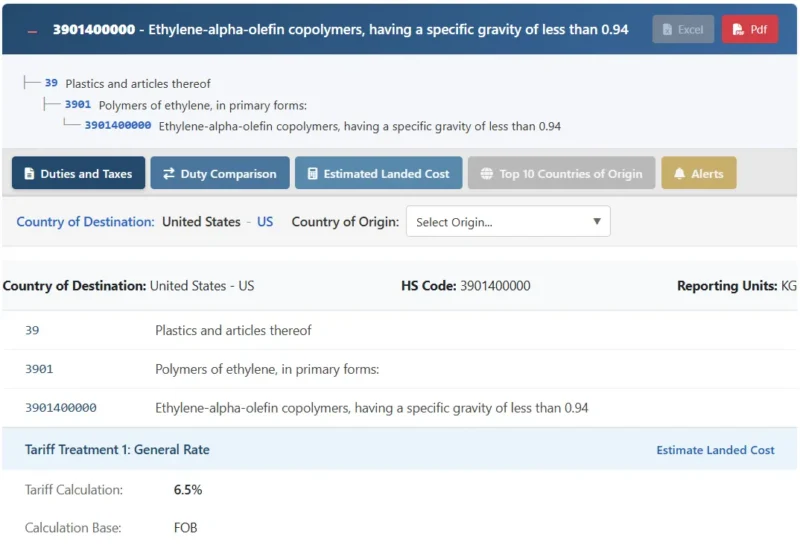
Users can research tariffs associated with specific HS codes, examine standard and country-specific rates, compare sourcing countries side by side, and estimate landed costs. Because Tariff Insights operates within Descartes Datamyne, tariff information can also be considered alongside supplier, shipment, company, and market intelligence.
The distinction is important. A tariff rate tells you what a product may cost to import. Trade intelligence helps answer a different question: where could you realistically source that product instead?
Combining those perspectives can make tariff research more useful for sourcing and procurement decisions.
Tariff Insights vs. Traditional Tariff Research at a Glance
| Area | Traditional Tariff Research | Descartes Datamyne Tariff Insights |
|---|---|---|
| Tariff lookup | Search official schedules and other resources individually | Search tariff information within Descartes Datamyne |
| HS code research | Often completed through separate classification resources | Search and validate HS codes alongside tariff information |
| Country comparisons | Repeat research for each origin and compile results | Compare multiple sourcing countries side by side |
| Landed-cost analysis | Typically calculated separately or in spreadsheets | Landed cost estimation integrated into the workflow |
| Supplier research | Usually requires another database or process | Trade and supplier intelligence available within Descartes Datamyne |
| Workflow | Multiple resources and manual steps | More consolidated research and analysis |
| Complex legal interpretation | Provides direct access to authoritative primary resources | Complex or high-risk questions may still require official confirmation or specialist guidance |
| Best suited for | Detailed compliance research and exceptional cases | Recurring sourcing, procurement and tariff scenario analysis |
Where Tariff Insights Has an Advantage: Speed and Consolidation
One of the biggest differences is the number of steps involved. Imagine a procurement team evaluating the same component from suppliers in five countries.
Source: Descartes Datamyne Tariff Insights
Using a traditional workflow, an analyst may need to research the classification, identify applicable rates for each country, record those rates, calculate their financial effects, and then use another data source to investigate whether qualified suppliers actually exist in each market.
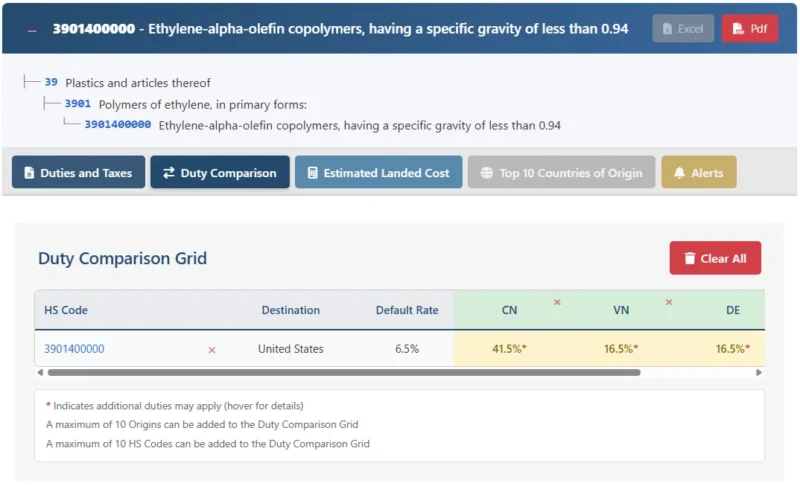
With Tariff Insights, much of that research can take place within the same platform. Tariff information can be reviewed at the product level, countries can be compared side by side, and the resulting cost implications can be evaluated without repeatedly moving between unrelated resources. Descartes Datamyne can then provide additional trade intelligence to investigate the markets and suppliers behind those sourcing options.
The value lies in reducing the friction between finding the tariff, understanding its financial impact, and deciding what to do about it.
Where Tariff Insights in Descartes Datamyne Has an Advantage: Comparing Sourcing Countries
This is especially important when tariffs are influencing sourcing decisions. Knowing that a product imported from one country faces a particular duty does not tell a procurement team whether another country represents a practical alternative.
A useful sourcing analysis may require answers to several questions:
- Which countries offer a more favorable tariff structure?
- What would the landed cost difference be?
- Which countries already manufacture or export the product?
- Which suppliers are actively serving similar markets?
- How significant is the trade relationship?
Traditional tariff tools generally address only part of the sourcing process.
Tariff Insights can compare tariff rates for the same product across different countries of origin, while the broader Descartes Datamyne platform can provide intelligence on suppliers, shipments and trade activity.
This makes tariff research part of sourcing analysis rather than an isolated compliance exercise.
Where Tariff Insights Has an Advantage: Landed-Cost Analysis
The tariff rate itself is not always the number decision-makers ultimately care about. They care about the cost of getting the product where it needs to go.
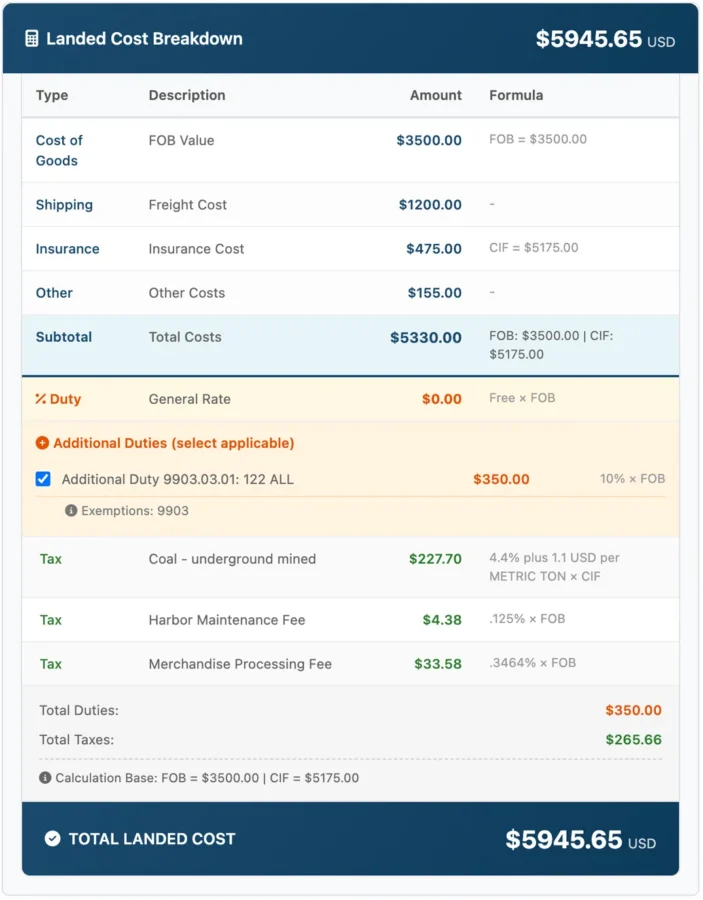
Traditional landed cost analysis frequently involves spreadsheets combining the product value with tariffs, duties, transportation, insurance and other expenses. These models can be effective, but they require data to be collected, entered and maintained.
Tariff Insights includes landed cost estimation to help users understand the cost implications of different sourcing scenarios before committing to a supplier. This can be particularly useful when relatively small differences in tariff exposure change the economics of a sourcing decision.
Source: Descartes Datamyne Tariff Insights
A supplier offering the lowest unit price does not necessarily represent the lowest cost option once duties and transportation expenses are considered.
Where Traditional Tariff Research Still Has an Advantage
There are circumstances where the traditional approach remains necessary. Tariff classification can involve interpretation. Products may have unusual characteristics, multiple possible classifications, special provisions, exemptions, or circumstances that require a detailed review of regulations and rulings.
Similarly, a high-level sourcing analysis is different from making a legally consequential customs declaration.
When the answer will determine how goods are formally entered, whether a particular trade program applies, or how an unusual regulatory provision should be interpreted, organizations should continue to validate decisions using authoritative government information and qualified customs or trade compliance expertise when appropriate.
Tariff Insights can accelerate research and provide valuable decision support, but software does not eliminate the need for professional judgment. The distinction is important for any organization evaluating tariff technology.
Does Tariff Insights Eliminate the Need for Tariff Expertise?
No. It changes where that expertise is most valuable.
Traditional processes can require specialists to spend significant time collecting information before they can begin interpreting it. A more consolidated platform can reduce some of that research burden so experienced professionals can focus more attention on exceptions, strategy and risk.
At the same time, making tariff information easier to access can help procurement and supply chain professionals answer routine sourcing questions without requiring a compliance specialist to manually research every scenario.
The result is not necessarily fewer experts. It can be better use of their expertise.
What About Cost?
Some government tariff resources are publicly available at no charge, which can make traditional research appear inexpensive, but the database itself is only one component of cost.
Organizations should also consider analyst time, the number of countries and products being researched, additional trade databases, spreadsheet maintenance, external consulting or broker support, and the cost of delayed sourcing decisions.
Tariff Insights requires access to Descartes Datamyne, so there is a software investment. Whether that investment makes sense depends largely on how frequently your organization conducts tariff, sourcing and global trade analysis.
For an organization conducting an occasional tariff lookup, traditional resources may be adequate. For a company continuously evaluating products, suppliers and sourcing countries, the productivity and consolidation benefits of an integrated platform become more significant.
Which Approach Is Better for Your Organization?
The answer depends on the problem you are solving. Traditional tariff research may make more sense when tariff analysis is infrequent, your team already has established compliance processes, or the research involves a highly specialized legal or classification question.
Tariff Insights becomes more valuable when tariff exposure is regularly influencing sourcing, procurement, pricing or supply chain decisions.
An occasional lookup asks “What is the tariff rate?” Sourcing analysis asks “How does this tariff change my sourcing options?” Answering the latter requires tariff information, cost analysis and trade intelligence together.
The Best Approach May Be Both
Tariff technology and traditional tariff expertise do not need to be competing approaches. A procurement team might use Tariff Insights to evaluate several sourcing markets, compare tariff exposure and estimate landed costs. Once the organization identifies a preferred option, its trade compliance team can conduct any additional classification or regulatory validation required before implementation.
This combination provides the speed needed for strategic analysis while preserving the controls required for high-stakes compliance decisions.
The Bottom Line
Traditional tariff research gives organizations direct access to authoritative resources and remains essential for complex classification and compliance questions. Its drawback is that researching and comparing multiple sourcing scenarios can require considerable manual effort.
Descartes Datamyne Tariff Insights is designed to make that broader analytical process easier. It brings product level tariff information, country comparison and landed cost analysis together with the supplier and global trade intelligence available in Descartes Datamyne.
For organizations dealing with frequent tariff changes or evaluating global sourcing alternatives, that can turn tariff research from a lookup exercise into a more actionable sourcing workflow.
See Descartes Datamyne Tariff Insights in Action
Want to see how different countries, tariff rates and landed costs compare for the products your organization imports?
Request a personalized demonstration of Descartes Datamyne Tariff Insights and explore your own sourcing scenarios.