
Tariff volatility is no longer a temporary disruption. For importers, manufacturers, distributors, and sourcing teams, changing trade policies have become an ongoing operational risk that can quickly impact margins, supplier relationships, and long-term sourcing strategies.
The challenge is not simply tracking tariffs. It’s understanding how tariff changes affect real-world sourcing decisions before costs escalate, suppliers become uncompetitive, or supply chains lose flexibility.
And many businesses are still making those decisions with fragmented data, manual research, and limited visibility into landed cost exposure, which creates risk.
Leading global trade teams are now taking a different approach — using tariff intelligence to proactively identify sourcing opportunities, reduce uncertainty, and protect profitability before trade conditions shift again.
That’s where Tariff Insights in Descartes Datamyne™ can help.

In this article…
- Tariff volatility is increasing sourcing risk and cost uncertainty.
- Manual tariff research can slow procurement decisions.
- Tariff Insights in Descartes Datamyne helps analyze tariffs and landed costs faster.
- Compare sourcing countries side by side within one platform.
- Reduce uncertainty with better tariff and HS code visibility.
- Identify lower-cost sourcing opportunities more quickly.
- Improve supply chain resilience with data-driven sourcing decisions.
- Descartes Datamyne helps teams respond faster to changing trade conditions.
Why Tariff Visibility Has Become Critical for Global Trade Teams
Tariffs can alter sourcing economics almost overnight. A supplier that was cost-effective six months ago may now introduce unexpected landed costs, compliance exposure, or sourcing instability due to new duties, reciprocal tariffs, or changing trade agreements.
Without clear visibility, organizations risk:
- Paying higher-than-expected import costs
- Losing margin due to inaccurate landed cost calculations
- Remaining dependent on high-risk sourcing regions
- Reacting too slowly to trade policy changes
- Missing lower-cost sourcing alternatives
For procurement and supply chain leaders, the pressure is significant. Decisions must be made quickly but they also need to be defensible, data-driven, and low risk.
Move Beyond Manual Tariff Research
Many sourcing teams still rely on spreadsheets, disconnected tariff databases, or time-consuming manual research to evaluate sourcing scenarios.
The problem is that fragmented research slows decision-making precisely when speed matters most.
Tariff Insights in Descartes Datamyne helps organizations simplify tariff analysis by combining tariff intelligence with global trade data and sourcing visibility in a single platform.
Instead of manually comparing markets and tariff schedules, teams can quickly:
- Analyze tariffs by HS code
- Compare sourcing countries side by side
- Estimate landed costs more accurately
- Evaluate sourcing alternatives faster
- Identify potential tariff exposure earlier
This allows businesses to make more confident sourcing decisions while reducing operational uncertainty.
Reduce the Risk of Costly Sourcing Decisions
In today’s environment, waiting too long to reassess sourcing strategies can become expensive.
Tariff increases, shifting trade policies, and geopolitical instability can rapidly affect supplier competitiveness and landed costs. Businesses that lack visibility often discover these impacts after margins have already been affected.
Tariff Insights helps organizations reduce that risk by giving decision-makers clearer intelligence before sourcing changes become urgent.
With better visibility into tariff exposure and country-level sourcing comparisons, businesses can proactively identify opportunities to:
- Diversify suppliers
- Reduce tariff-related costs
- Improve sourcing flexibility
- Protect margins
- Strengthen supply chain resilience
Built for Faster, More Confident Decision-Making
Global sourcing decisions are rarely simple. Procurement leaders must balance cost, compliance, supplier reliability, and operational continuity, often under tight timelines. That’s why clarity matters.
Tariff Insights is designed to help reduce complexity and improve confidence during sourcing evaluations.
Using Tariff Insights, teams can:
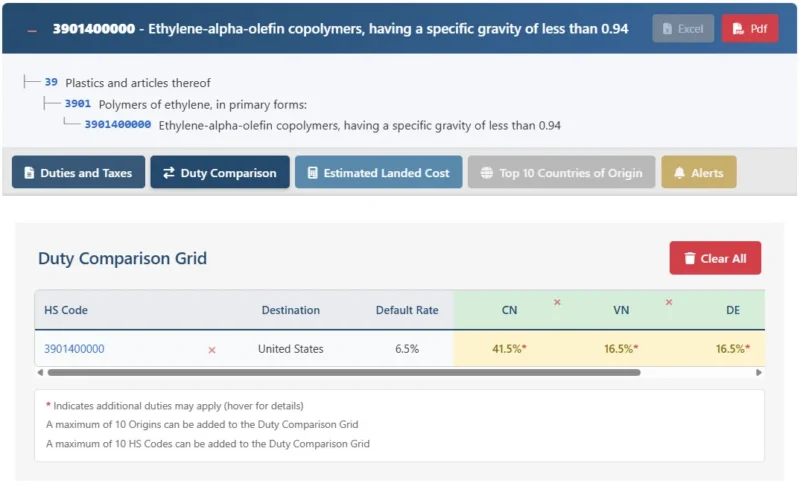
1. Compare Tariffs Across Multiple Countries
Quickly evaluate sourcing markets side by side to identify regions with lower tariff exposure and stronger cost advantages.
Source: Descartes Datamyne Tariff Insights.
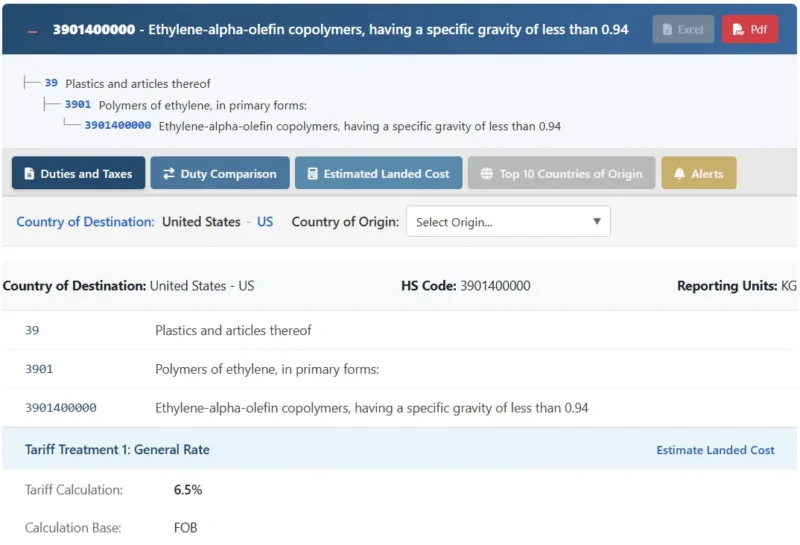
2. Validate HS Codes and Tariff Classifications
Reduce uncertainty tied to product classification by researching HS codes and associated tariff schedules within the same workflow.
Source: Descartes Datamyne Tariff Insights.
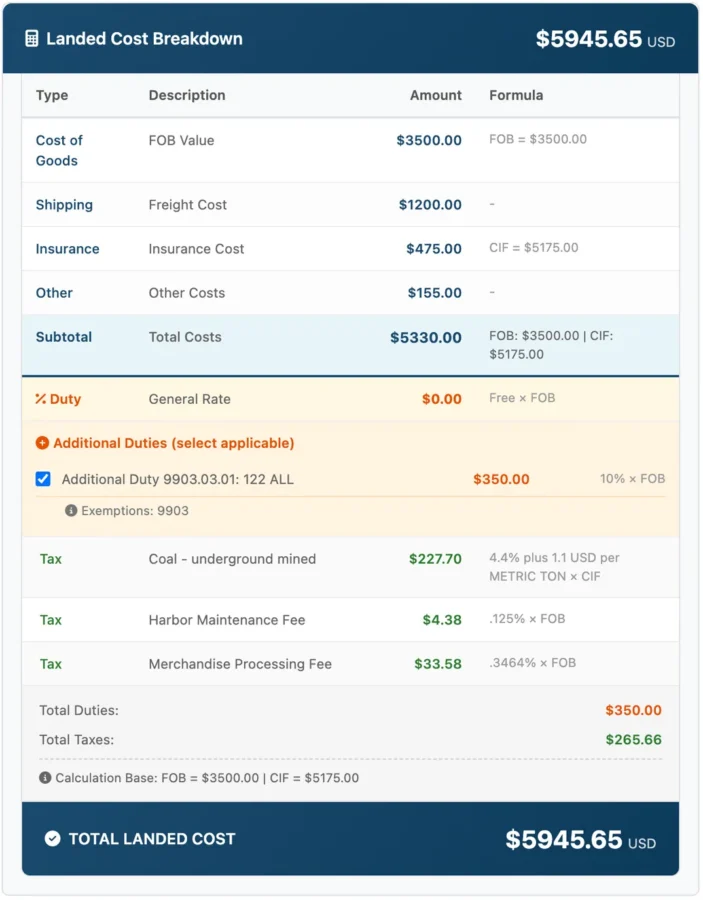
3. Estimate Landed Costs Before Committing
Understand the broader financial implications of sourcing decisions earlier in the process to support more accurate forecasting and budgeting.
Source: Descartes Datamyne Tariff Insights.
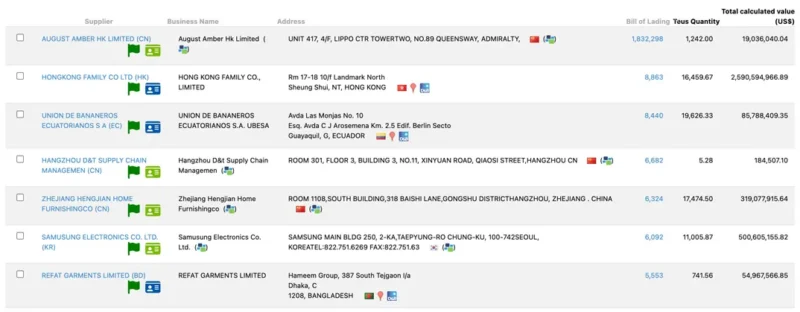
4. Identify Opportunities Faster
Combine tariff intelligence with Descartes Datamyne’s global trade data to uncover supplier, sourcing, and market opportunities more efficiently.
Source: Descartes Datamyne Tariff Insights.
Why Leading Trade Teams Are Prioritizing Tariff Intelligence
The most resilient organizations are not simply reacting to tariff changes after they happen.
They are building sourcing strategies designed to adapt faster, reduce risk earlier, and improve decision-making confidence before disruption occurs.
Tariff intelligence has become a competitive advantage because it helps businesses:
- Respond faster to changing trade conditions
- Avoid costly sourcing blind spots
- Make better-informed procurement decisions
- Reduce uncertainty across supplier networks
- Stay competitive in volatile global markets
As trade complexity continues to increase, organizations that lack tariff visibility may find themselves operating at a disadvantage.
Gain Better Visibility Into Global Tariffs With Descartes Datamyne
Tariff Insights in Descartes Datamyne helps procurement, sourcing, and global trade teams analyze tariff exposure, compare sourcing markets, and estimate landed costs with greater confidence.
By combining tariff intelligence with one of the world’s largest global trade databases, businesses can move faster, reduce uncertainty, and make more informed sourcing decisions in an increasingly volatile trade environment.